

The National Climate Assessment is the bedrock Federal state-of-the-science report delivered to Congress every four years. It is one of the statutory requirements of the 1990 Global Change Research Act. The White House Office of Science and Technology Policy is seeking comments on proposed amendments to the 5th National Climate Assessment (NCA5) that would manipulate the results and downplay the damages of climate change.
https://www.federalregister.gov/documents/2026/08/25/2026-17289/united-states-global-change-research-program-availability-for-public-comment-on-the-proposed
The NCA5 is designated a Highly Influential Scientific Assessment and underwent extensive formal review and comment before publication in 2023. The process included an independent review by the National Academies of Sciences, Engineering, and Medicine and multiple levels of scientific, technical, government, and public review and comment. The report was published following formal approval by the 15 federal agencies that comprise the US Global Change Research Program.
The objectives of the proposed changes are to eliminate the high emissions scenarios from consideration and downplay the negative consequences of climate change. OSTP is planning to require that all agencies adhere to the following interpretive guidelines and that the text of NCA5 be altered to be consistent with these guidelines:
“Any NCA5 result based on RCP8.5, SSP5-8.5, or equivalent high forcing should be treated as an implausible scenario output and should not be used as a policy, planning, regulatory, public-communication, or grantmaking premise unless independently reproduced under a plausible current-policy, or updated scenario and evaluated against observations.
Any NCA5 figure, map, table, caption, callout, chapter highlight, regional summary, or impact statement that presents a high scenario result should carry the scenario label and the implausibility caveat in the same sentence, caption, box, or summary where the projected impact is communicated.
Severe late-century claims involving damages, health effects, infrastructure costs, ecosystem disruptions, sea-level impacts, agricultural impacts, regional extremes, labor effects, migration, or adaptation costs should not be used in policy-making unless scenario dependence is disclosed, a plausible comparator is provided, and the claim is compared with observations.
RCP8.5, SSP5-8.5, or equivalent pathways are not policy relevant, and should not be used in authoritative federal work products.
Research-only technical use of high pathways does not make the resulting impact estimate policy-plausible”.
— Caution Acronyms Ahead —
Each of the National Climate Assessments produced to date rely on scenarios that give alternative perspectives on what the future might hold. The 5th NCA relied on five specific emissions/climate scenarios: Very Low; Low; Intermediate; High; and Very High (see the figure below). You will see these scenarios labeled SSPs or RCPs. These terms stand for Shared Socioeconomic Pathways (SSP) or Representative Concentration Pathways (RCP). The Very Low, Low and Intermediate scenarios include significant global action to reduce greenhouse gas emissions. The High and Very High scenarios are based continued or increasing dependance on fossil fuels. They include significant population growth and vary in levels of economic growth and technological change. Under the High and Very High scenarios, countries pursue little or no greenhouse gas reduction. Back when I worked on emission projections in the 1990s (ancient times) we labeled our version of the very high scenario “Fossil Fuels Forever.” We called the low emission scenario “Everyone Goes Dutch.”
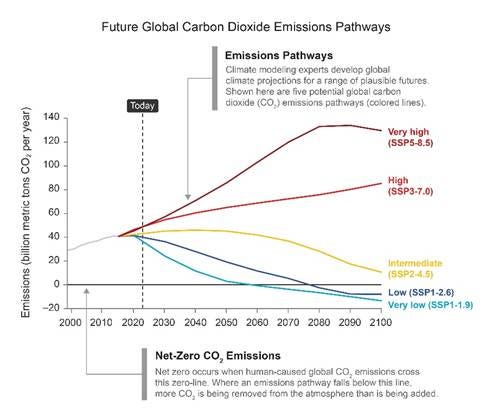
By proposing to ignore both the Very High and High scenarios, OSTP is either playing a cynical game or suffering from an extreme lack of self-awareness. They apparently have not looked across the street toward the White House which is doing their very best to increase the costs of renewable technologies, expand fossil fuel use, and undermine any international effort to address climate change.
The scenarios used in NCA5 were developed by the World Climate Research Programme (WCRP) under a process known as the Coupled Model Intercomparison Project (CMIP). The NCA5 used scenarios from CMIP6. These scenarios are being revised under CMIP7 (I warned you about the acronyms!)
OSTP is playing fast and loose with the facts. They are seizing on changes being made by CMIP7 that revise the highest emission scenarios down. But, (and it is a big but) while CMIP7 revised the high end of the emissions projections downward, the high-end effects (4⁰C by 2100) are still very much in play. Here is what the CMIP7 team has to say:
“The (new) High scenario results in lower emissions than the previous high scenarios known as RCP8.5 (CMIP5) and SSP5-8.5 (CMIP6). The main reasons for this are:
Emissions in recent years have largely followed the CMIP6 middle-of-the-road scenario and not the high emission scenario. This new starting point alone results in lower overall projection during the 21st century at the high end.
The cost of renewable energy has declined faster than expected. As a result, the high end of the range of plausible increases in fossil fuel use is lower than in previous scenarios.
… but warming above 4°C remains possible
Although 21st century emissions in the highest CMIP7 scenario are lower than in CMIP6, this does not rule out high-impact climate change. First, the preliminary estimate of warming in 2100 in this scenario is still around 3.5°C above the pre-industrial level — a level at which severe climate impacts could occur. Second, the estimated temperatures in the High scenario continue to rise after 2100, suggesting a delay in reaching an equivalent level of global average warming by several decades when compared to the highest emission scenario from CMIP6. Third, the sensitivity of the climate system may be higher than our best estimate, and feedbacks between climate change and the carbon cycle might hamper carbon sinks or cause an additional release of greenhouse gases. In that case, global temperature increase could still exceed 4°C. The recent record-breaking temperatures in 2023, and again in 2024, are a reminder of how uncertainties and gaps in our knowledge make a strong temperature increase a low-likelihood, high-impact consequence of our emissions.”[2]
Curiously, OSTP does not question the plausibility of the NCA5 Very Low emissions scenario (SSP1.9) which relies on immediate and drastic greenhouse gas emission reductions and global net negative emissions by the middle of the century. The same group of international WCRP researchers that concluded that the very high emissions scenarios might be too high also concluded that the ship has sailed on the very low emissions scenarios. They state “…Previously, it was still possible to design plausible emissions pathways that kept warming from exceeding 1.5°C. Because emissions have continued to rise in recent years, this is no longer possible.”
My personal view is that the WCRP CMIP team may have jumped the gun in declaring the Very High SSP8.5 scenarios to be implausible. I understand their perspective. The Highest CMIP6 scenarios were the result of expanded coal production and consumption. The researchers were observing advances in renewable technologies, a level of international cooperation, and commitments from governments and the private sector to take serious action and transition from fossil fuels.
The Trump Administration is undermining all of this progress. In the last 20 months, the Administration has:
Issued an executive order on Clean Beautiful Coal – making it federal policy to promote and expand coal production, use and exports.
https://www.whitehouse.gov/presidential-actions/2025/04/reinvigorating-americas-beautiful-clean-coal-industry-and-amending-executive-order-14241/)
Removed the US from the Paris Agreement and the Framework Convention on Climate Change, leaving a gaping hole in climate diplomacy and removing pressure on others to act;
Destroyed the Agency for International Development and substantially curtailed the capability for the US to provide technical and development assistance to encourage economic growth and help countries address climate change;
Eliminated federal support for wind and solar power, going as far as using taxpayer dollars to buyout existing projects;
https://blogs.edf.org/climate411/2026/07/30/trump-admin-blocking-clean-energy-and-raising-costs/
Encouraged the extension of coal fired power plants over the objections of the plant owners;
https://www.energy.gov/articles/fact-sheet-energy-department-unleashing-beautiful-clean-coal
For anyone wanting to let OSTP know what you think, they have only provided a short 15-day window to provide comments. Comments are due on September 9, 2026.
Here is a preview of what I plan to say:
Rather than manipulating the 5th National Assessment, the Trump Administration should focus its efforts on preparing the 6th National Climate Assessment – which is due to Congress in 2027.
If they choose to proceed, any changes or additions to the NCA5 should undergo the same level of scrutiny and review as the original document, including National Academy review, technical and scientific review, public comment, and agency review and approval.
The authors of the report should be consulted and given an opportunity to remove their names from the report.
The amendments should also note that removing the existing high emissions scenarios leaves a gaping hole in the report and that the remaining scenarios are not representative of potential futures.
Preferably, the Administration should simply turn the page and focus on NCA6. In NCA6, a new set of High and Very High emissions scenarios will be needed to reflect Administration policy. This should include the following assumptions:
Promotion and expansion of fossil fuels, in particular coal production and consumption;
Elimination of policies, incentives and research to develop and expand renewable energy – especially wind and solar;
Diminished reliance on international institutions;
Greater wealth disparities;
Reductions in development assistance; and
Increased trade barriers
While the WCRP may have concluded that the world just might have avoided the absolute very worst climate change outcomes, the Administration is trying its best to resurrect them. It seems appropriate that OSTP reflect the Administration efforts in the next National Climate Assessment.
William Hohenstein was the Director of USDA’s Climate Change Program Office and Office of Energy and Environmental Policy from 2000 to 2026. He served as the USDA Principal to the US Global Change Research Program during this period.
https://nca5.climate.us/
[2] https://wcrp-cmip.org/explainer-scenarios-for-cmip7/
A very nice synthesis. Thanks, Bill. There is also a huge process red flag (not that we need any more red flags): All assessments like NCA5 represent the authors' best reading and synthesis of the evidence at a particular point in time. That's why we have a process for updating them periodically (in this case producing NCA6 -- which the US Government would have been doing for the past couple of years had the current leadership in the Executive Branch been following the law -- https://www.science.org/doi/10.1126/science.adz3885). Since when in ANY assessment process has anyone picked one particular aspect of the assessment years after publication and proposed going back and "revising" that assessment?
It's perfectly reasonable to publish a paper calling attention to evidence for why a particular part of one of these massive assessments should be viewed differently in light of new developments. Events have always shifted the interpretation of previously-published work. Can you think of a single instance when the response has been to go back and revise the original, very thoroughly-vetted document?